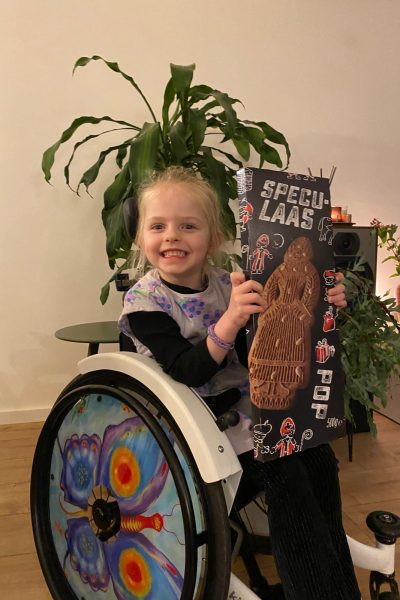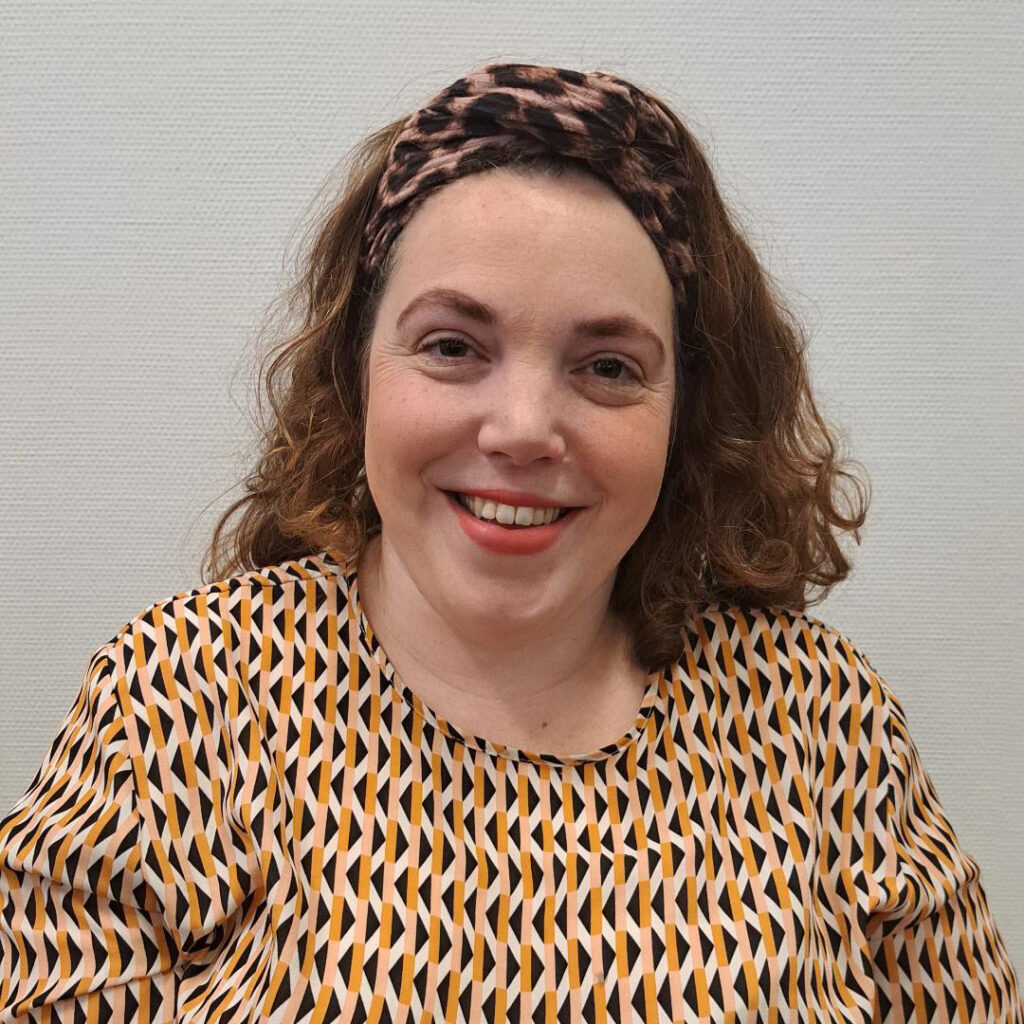
Maysoun (41) lives in Almere and still works as a management assistant in mental health care. She is social, positive, and enjoys cooking, fermenting foods, and going out on her mobility scooter whenever possible. But behind that positive attitude lies a life in which adapting, letting go, and finding balance again are part of her daily reality. Together with her mother and her 10-year-old daughter, she lives with HSP.
Diagnosis & Discovery
“I’ve actually been in and out of hospitals since I was two years old,” she says. Her mother also has HSP, so it became clear at an early age that she had the same condition. Her mother’s diagnosis followed concerns about oxygen deprivation at birth. When similar signs appeared in Maysoun, the medical puzzle was quickly solved. From the moment she started walking, her feet turned inward and she walked on her toes. As a child, she wore casts, used braces, and began physiotherapy at the age of eight. “I remember being involved in medical treatments from the age of four.” At school, physical education was challenging, and she often fell. Yet she always maintained a positive outlook. “My glass is always half full. I managed.” Her father played an important role in that. “He always joined school trips so I wouldn’t have to walk everywhere.”
Since the age of 26, she has received botulinum toxin treatments. “It doesn’t take the condition away, but it helps enormously.” In the end, the name of the condition mattered less to her than how she dealt with it. “I’ve always known it was HSP because of my mother. But for me, living my life was more important. You are who you are, not what you have.”

Impact on Daily Life
HSP affects her daily life constantly. Since July 2025, she has been wheelchair-dependent. She can still walk short distances with a cane, for example from the car to a doorway, but her mobility has changed dramatically. “It’s a form of living grief,” she says openly. “When I realized I could no longer walk the way I used to, I had to reorganize my entire life. You really have to make a mental shift.”
Energy management is another major factor. “Showering, getting dressed, or doing anything physically demanding costs a lot of energy. I plan my life carefully so I can save energy for the things I enjoy.” She uses a mobility scooter and drives a car with hand controls to remain as independent as possible.
“The biggest challenge?
Protecting my energy. I have to set boundaries for myself.” Household tasks have also become difficult. “Making a bed or doing laundry is no longer possible.” Still, she refuses to define herself by her limitations. “It’s important to keep seeing your own value.”
Because both she and her partner work, they do not qualify for additional assistance. Fortunately, she has a strong support network. “My friends help me enormously. I’m surrounded by wonderful people.”
Family & Recognition
HSP affects three generations of her family: her mother, herself, and her daughter. Yet each experiences the condition differently. “My mother was one of ten children and the only one with HSP. It was much harder for her because so little was known about it back then.”
She benefited from recognition and guidance. “My mother was an example for me. Despite everything, she lived a normal life.” She can talk openly with her daughter about the condition. “We understand each other well and can share a lot.” Today, care and support services are also much better organized. Whereas physiotherapy once consisted mainly of painful stretching exercises, the focus is now on balance, mindful movement, and preventing falls and pain. She still attends weekly physiotherapy sessions with a neurological therapist, performs daily exercises, and has also participated in hydrotherapy.
Find Something New That You Can Still Do
She describes disease progression as “a continuous process of saying goodbye.” Time and again she has had to give things up: walking, bending down, climbing stairs, and independence. “It’s a constant process of accepting that certain things are no longer possible.” Yet she has found her own way of dealing with these changes. She consciously seeks happiness in small things. “I’m very social. My friends, cooking, and fermenting make me happy.” When her condition suddenly worsened, she taught herself how to crochet. “Just find something new that you can still do.” On sunny days, she enjoys going out on her mobility scooter. “You have to keep looking at what is still possible.”
What helps her most is structure, acceptance, and recognition. “Doctors don’t always need to have a solution immediately, but I do want to feel heard.”
You Are Not HSP
According to her, many people do not understand how complex HSP really is. “People often think only of stiff muscles, but it’s actually a combination of overactive muscles and muscles that do not function properly. That creates unusual strain throughout the body.” Balance is therefore incredibly important—and at the same time the hardest thing to achieve.
Her most important message to others with HSP and to those around them is clear:
“You are not HSP. It is something you have. I want to focus on who I am: my strengths, my character, and my life. That is so much bigger than a diagnosis.”
She also hopes that future research will focus more on the underlying causes of HSP.
“In my case, the cause lies in the nerves, and there is still very little that can be done about that. Most treatments today focus on managing symptoms. I hope that one day more attention will be given to the real cause.”
Would you like to share your story as well? Let us know via email at office@life4hsp.com.
 English (UK)
  Nederlands
  Français
  Italiano
  Deutsch
  Español