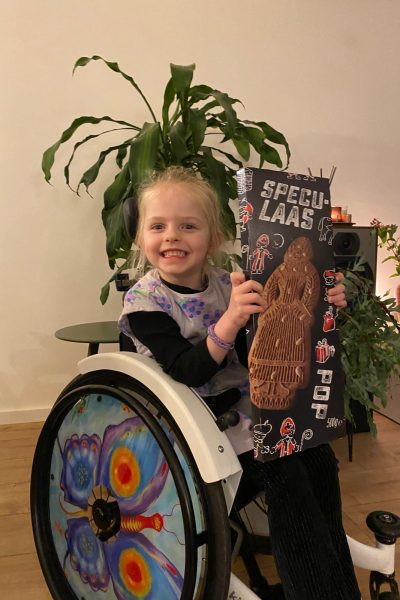
Naomi has been living with HSP (Hereditary Spastic Paraplegia) for 35 years.
My story began at a very young age. Around my second birthday, my mother noticed that something wasn't quite right. I hardly crawled, and whenever I tried to stand, my legs would simply give way beneath me.
The child health clinic thought I was just a late bloomer, but my mother trusted her instincts. Through our family doctor, we were referred to the hospital. What followed was a period of tests and uncertainty until I was finally diagnosed with Hereditary Spastic Paraplegia (HSP). Of course, I don't consciously remember that time, but for my mother it was incredibly difficult. From the very beginning, she did everything she could to make sure I received the care I needed. I still admire her enormously for that. No one else in my family has HSP, so in that sense, I was simply unlucky.
Living with a progressive neurological disorder
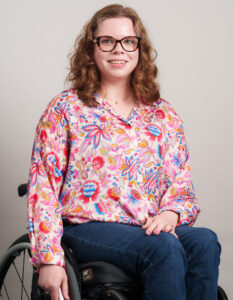
A wheelchair has been part of my life for as long as I can remember. Since my teenage years, I have been fully dependent on one. I also deal with back pain, muscle spasms, bladder and bowel problems, and an energy level that works very differently from that of most people. To remain as independent as possible, I rely on a variety of assistive devices and home adaptations. I wear custom-made shoes, and at home I have an adapted bed, a shower chair, and an accessible kitchen. I also take medication, including medicine to help control my muscle spasms.
In addition, I attend physiotherapy three times a week. My therapist stretches my leg muscles, helps keep my back flexible, and guides me through exercises to maintain the strength in my back and arms.
Sometimes the biggest challenge is mental
Although my physical limitations are visible, I often find the mental side of living with HSP even more challenging. HSP is a progressive condition, which means that something changes almost every year. Things I was able to do five years ago may no longer be possible today. Accepting that is not always easy. In my mind, there is still so much I want to do, while my body increasingly reminds me of its limits. That's why I have to carefully manage my energy and deliberately build moments of rest into my day. Another major source of stress is arranging care and assistive equipment. The bureaucracy can be overwhelming, and it often feels as though you constantly have to prove that you have a disability. That frustration can weigh heavily on my mind.
Still, I try to stay positive. Of course, there are days when I feel angry or sad, and those emotions deserve their place too. But afterwards, I always try to focus on the things that make life beautiful. Because despite everything, life is still far too wonderful not to enjoy.
The support of my parents
One of the biggest reasons I can always find my way back to a positive outlook is my parents. They have always been there for me, and they still are. They can no longer take over the practical responsibilities, but because they have been with me from the very beginning, they understand better than anyone what I'm going through.
It's comforting to talk to them and get things off my mind. We often discuss the challenges surrounding healthcare and assistive devices. They also notice how much more complicated everything has become. The quality of support services is under increasing pressure, while the paperwork and administrative burden continue to grow. We also talk about how society views people with disabilities. There is a lot of discussion about inclusion, diversity, and accessibility, but in reality, there is still a long way to go. Because of my disability, I am still regularly seen as "different," and that can be painful.
Fortunately, my parents have always taught me that I am no less valuable than anyone else. That is something I carry with me every single day.
Work, friends and my cat Oliver
As long as there are no major issues with my care or assistive equipment, I truly enjoy my job as a Programme Advisor at Nyenrode. I work 32 hours a week and am grateful that I have been able to make flexible arrangements with my employer. Working from home is also an option whenever necessary. Outside of work, I enjoy reading, going on day trips, shopping, dining out with friends, and visiting the cinema.
And then, of course, there's Oliver—my cat and my little companion. On days when I feel down because of my disability, he makes sure I don't stay in bed all day. He simply expects breakfast, some cat milk, and plenty of attention. And honestly, sometimes that helps more than anything else.
What I want people to know about HSP
I wish more people knew about HSP. It is a rare, progressive neurological disorder, which means that life with HSP doesn't look the same from one year to the next. What someone was able to do five years ago may no longer be possible today. That can make it difficult for others to understand what living with HSP really means. There is also still far too little research into this condition. We don't yet know enough about the most effective treatments or which medications may offer real benefits. More research is urgently needed.
That is why the work of Life4HSP is so important.
You are not alone
If there is one thing I would like to say to other people living with HSP and to their loved ones, it is this:
Trust your instincts. Keep talking to healthcare providers and organisations about the care and support you need, even when it feels frustrating and you feel like giving up. And don't forget to focus on the things you can still do. There are still so many beautiful moments, wonderful people, and meaningful experiences to enjoy.
And perhaps most importantly: you are not alone.
Do you have a story about living with HSP that deserves to be heard? We'd love to hear from you. Share your story by emailing us at office@life4hsp.com.
Would you like to make a difference for people living with HSP and support vital research and awareness? Please consider making a donation to Life4HSP.
 English (UK)
  Nederlands
  Français
  Italiano
  Deutsch
  Español