Voor Anne is HSP (SPG4), een erfelijke vorm van hereditaire spastische paraparese, altijd onderdeel van haar leven geweest. Haar moeder kreeg de diagnose toen Anne nog jong was. Samen vertellen ze hoe de ziekte hun dagelijks leven beïnvloedt, maar ook hoe ze blijven kijken naar wat wél mogelijk is.
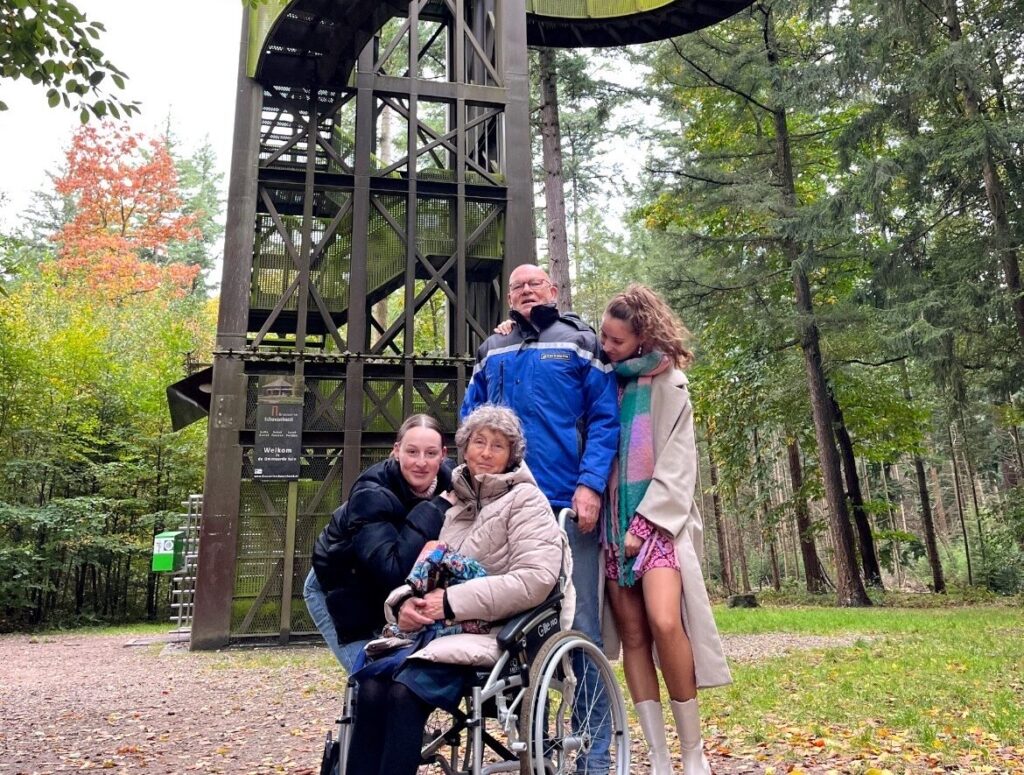
For Anne’s mother, the impact of HSP begins the moment she gets out of bed. “HSP affects my life day and night,” she says. “Getting up, getting dressed, walking, and even simple daily tasks take much more time and energy.” Their home has been adapted to make daily life easier. A stairlift helps her move between floors, and for longer distances she uses a wheelchair. For short walks, she still relies on two walking sticks. Even household chores have become challenging. “Moving pots and pans, lifting a bucket, or cleaning is often no longer possible. That’s why I use a small trolley around the house to carry things.”
The condition has not only changed her life but also that of the entire family. Every outing requires careful planning: Is the location wheelchair accessible? Are there any steps? Is there an accessible toilet nearby?
Growing Up with HSP
HSP runs in the family. Anne’s mother, uncle, and aunt all have SPG4. Her mother was diagnosed around the age of forty. “I was four or five years old when my mother was diagnosed,” Anne recalls. Anne recalls. “The disease progressed gradually, so I grew up with it.” It wasn’t until she got older that she realized her mother walked differently from other parents. “The mothers of my friends walked much faster. That was when I really understood that my mother moved differently.”
Managing Energy
Almost everything requires extra energy, making careful planning essential. “If I do too much or walk for too long, I’m completely exhausted,” her mother explains . “I can’t do everything in one day. After dinner I often need to sleep for a while, and in the evenings I usually stay home.” Despite this, staying active remains important. She attends physiotherapy, exercises regularly, and enjoys cycling on her adapted three-wheeled bicycle. Swimming and visiting the sauna also help keep her muscles flexible. “I have the most energy in the morning. That’s when I try to do the things that matter most.”
Choosing Joy
Receiving the diagnosis brought sadness. “You feel far too young and still have so many plans.” Even so, she refuses to let the disease define her. “I enjoy the things I can still do. I’ve always been optimistic, and I try to hold on to that.” Volunteering at a day care center for people with dementia gives her great satisfaction. She also enjoys cycling, reading, playing games with her family, and doing word puzzles. “A good day is a day when I have a purpose—something meaningful to do.”
A Remarkable Mother
Ondanks de ziekte kijkt Anne met warme gevoelens terug op haar jeugd. “My parents always took us on holidays and organized lots of activities. I never felt like I missed out on anything.” As a teenager, however, she sometimes found it difficult when people stared at her mother. “Back then, I sometimes felt embarrassed. Now, what I feel most is admiration.”
She describes her mother as kind, optimistic, and caring. “I admire her determination so much. Despite everything, she gets up every single day and makes the best of it.”
Living with Uncertainty
Because HSP is hereditary, the future also plays an important role. “I’ve been tested several times to see whether I carry the gene, but so far there’s still no clear answer.” That uncertainty has shaped the way Anne lives. “I make the most of life. I travel a lot, I’m very active, and I even walked 110 kilometres in 24 hours to raise money for HSP—also because I can still do it now.” Her sister has made a different choice and prefers not to know, for now, whether she carries the gene. “It remains a difficult subject. My mother’s greatest hope is that the disease ends with her generation.”
Caring with Love
Most of the care for Anne’s mother is provided by Anne’s father, but Anne also helps wherever she can. “I became responsible at a young age. You’re always thinking about what still needs to be done at home.” Yet she never experiences caring for her mother as a burden. “We’re incredibly close. Everything we do, we do out of love.” At the same time, Anne believes families like theirs need more practical and financial support. For example, her mother would like to receive household assistance, but this has been denied under the Dutch Social Support Act (Wmo) because Anne still lives at home.
“See the Person First”
According to Anne, there should be greater awareness of the less visible consequences of HSP. It is not only the difficulty with walking but also fatigue, bladder problems, memory issues, and difficulty finding words that have a major impact on daily life. Her mother also notices that people often stare at her. “That’s not a pleasant feeling.”
If Anne could share one message with people who meet someone living with HSP, it would be simple: “Heb geduld. Wees vriendelijk en behulpzaam, maar behandel iemand niet anders. Achter de ziekte zit gewoon een mens.”
Despite all the challenges, the family continues to create special memories together. Two years ago, Anne took her mother on her dream trip to Rome. “With a wheelchair and with HSP. It wasn’t always easy, but we did it.” Soon, they will travel together to Lisbon. “We refuse to be held back. What matters most to us is continuing to enjoy the things we can still do.”
 English (UK)
  Nederlands
  Français
  Italiano
  Deutsch
  Español