The first signs as a child
“Where do I begin?” says Linda (46). “With myself, I suppose.”
As a child, Linda already noticed that she was somewhat less smooth motorically than others. During gym class, she had difficulty keeping up. She was somewhat stiffer, somewhat clumsier than her sister, but at the time little attention was paid to it. It simply belonged to her, everyone thought. Only years later, after her pregnancies, everything changed. Due to a hernia and persistent back complaints, she was referred to a neurologist. Not because of the way she walked, but because of a pinched nerve.
“Still, the neurologist said almost immediately: ‘Why do you walk with such difficulty?’I reacted irritably that I had come for a hernia, ‘I’m not exactly walking in doing a somersault, am I?’ But she really meant my walking pattern.”
Linda herself did not see anything unusual in it. Her mother walked like that. Her aunts too. Even her little daughter had the same ‘waddle,’ as she calls it.
An appointment that changed everything
What began as a check-up for back complaints suddenly turned into a medical process full of examinations. Within a short time, she was lying in the MRI scanner. Brain tumors, ALS and MS had to be ruled out. “I will never forget that moment. I was alone, because I thought I only had an intake appointment. The ground literally disappeared beneath my feet there. And for the first time I made the connection with my daughter.”
During the further examination, her family history was also discussed. An uncle on her mother’s side appeared to have HSP and is in a wheelchair. “At first I still laughed and said: ‘But he isn’t my father.’ Until they explained how heredity works. Then all the puzzle pieces slowly fell into place.”
The HSP diagnosis
Er volgde DNA-onderzoek voor haar en haar kinderen. Hoewel ze diep van binnen al wist wat de uitslag zou zijn, kwam de werkelijkheid alsnog hard binnen. Eerst kreeg zij de diagnose HSP. Vijf weken later volgde dezelfde uitslag voor haar dochter (17). “We hebben allebei HSP SPG31 reep 1.”
“That period still feels like mourning. Not only for myself, but especially for my daughter. You do not know what the future will look like. That uncertainty is sometimes even more painful than actually knowing something.”
Linda ended up in a dark period. She felt sadness, fear and above all guilt. “She got it from me. Of course people say I cannot help that, but that does not take away the guilt. I carry that with me every day as a mother.”
The lack of understanding from people around her sometimes made it even heavier. When someone said two months after the diagnosis: ‘Are you still so upset about that?’, she decided to withdraw more and more.
A new balance within the family
“I stopped sharing. I carried it myself, together with my family.”
During that period, her husband took over a lot within the family. “Sometimes I only watched how they had fun together. The children gravitated toward my husband and I could only cry. I truly wondered what my added value still was within the family.”
With the help of a psychologist and family therapy, space slowly began to emerge for processing, acceptance and a new balance.
“After a year, the love for life slowly returned. Everything gradually found its place.”
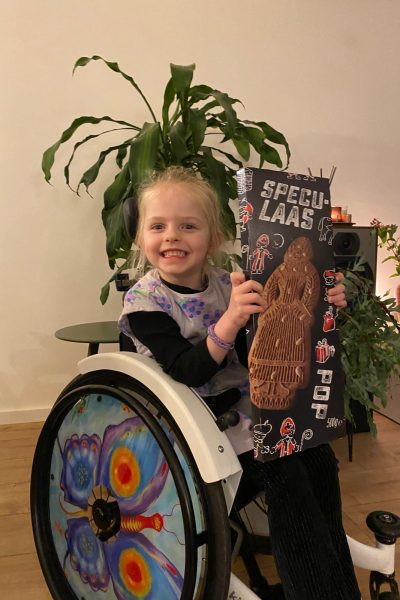
Now, three years later, she says that the family is “okay.” Not because HSP has disappeared, but because they have learned to live with it. Aids were added to the home, an adapted bicycle for her daughter and practical adjustments that make daily life easier.
“Even attending a concert sometimes requires extra preparation, such as arranging disabled seating for my daughter. Those are moments when the sadness suddenly comes back in.”
I am proud, but changed
Yet pride now also prevails. “I am absolutely no longer the Linda I used to be. I sometimes miss my old life, my carefree feeling, my network from back then. But my family, my marriage, my best friend and I ourselves have become so much closer. That is more precious to me than anything.”
Her diagnosis also led to difficult conversations within the family. Because if she and her daughter have HSP, it means other family members may possibly be dealing with it as well. “That sometimes caused unrest and changed certain relationships. Not everyone appreciated that. But I never wanted or caused this. I was only fighting for myself and for my daughter.”
Her son was eventually also tested. He turned out not to have HSP. Nowadays Linda can talk about her story better and better, although it sometimes remains confronting. “Sometimes it goes perfectly fine. And sometimes not at all. For example, when my daughter comes running toward me and I see that she is limping. Then that hurts.” But she has learned that sadness is allowed to exist. “Then I cry for three days, drink a good coffee and after that I get up again. And I continue. Together with my family, I can do that.”
Want to know more about living with HSP?
 English (UK)
  Nederlands
  Français
  Italiano
  Deutsch
  Español