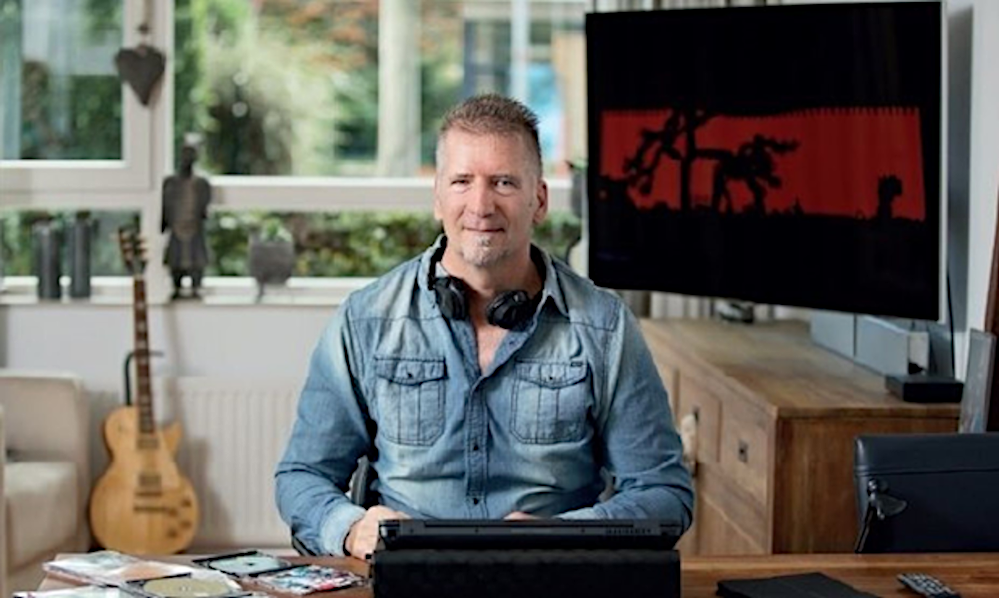
My name is William van Dalen. I am (still) 60 years old, married and have no children. Although I have been declared fully unfit for work, I still work 15% of the time as a technical specialist at an IT company. Around twenty years ago, an occupational expert from the Dutch Employee Insurance Agency (UWV) suggested that I could continue working part-time alongside my disability benefit. I am still very grateful for that suggestion. My job was suitable for this arrangement, and I am glad I was given that opportunity. Despite my physical limitations – or perhaps because of them – I have a positive outlook on life. I have developed a tremendous amount of perseverance and always try to focus on what I can still do.
Music and enjoying the little things in life
Music plays an important role in my life. I am particularly passionate about rock music. Every year, I attend several concerts with my brothers, my nephew and sometimes my wife. For many years, my greatest passion was playing the electric guitar. At some point, I noticed that it was becoming increasingly difficult to maintain my level of playing. My technique started to deteriorate, and eventually I decided to stop playing altogether. I found this extremely frustrating. What I did not know at the time was that HSP was playing a role in this. My guitar is still standing in our living room as a decorative piece. My 27-year-old nephew occasionally borrows it. He shares my passion for music and enjoys going to concerts with me, which I really love.
My wife and I also enjoy the little things in life: having coffee together at a café, going out for dinner, taking a weekend break or going on holiday. We both love Scandinavia and Northern Europe. But we are just as happy relaxing at home on the sofa, watching a good film or series together.
From clumsy teenager to an HSP diagnosis
Even as a teenager, I was known for frequently tripping over things. A raised paving stone, a loose electrical cable or a chair leg – I would easily catch my foot on them. At the time, I simply thought I was an awkward, clumsy teenager. It was only much later that I discovered there was a medical reason behind it. In 2001, I went to see a neurologist about my symptoms. After an MRI scan and a lumbar puncture, the conclusion was that there was nothing wrong with me. I disagreed and, somewhat angrily, insisted on getting a second opinion. Through the former MS Centre, I eventually ended up at Radboud University Medical Center in Nijmegen, where I was seen by the predecessor of Professor Van de Warrenburg. The initial diagnosis was cerebellar ataxia. However, it was not until 2009 that DNA testing finally revealed what was really going on: I had a complicated form of hereditary spastic paraplegia (HSP).
Until mid-2008, I was still able to walk without any aids. That was not always easy. I regularly noticed that people did not understand what was wrong with me. Sometimes I felt they were looking at me and thinking: ‘Is he drunk already at this time of day?’ When I started using a walking stick, people's reactions changed and much of the misunderstanding disappeared. And when I occasionally used a wheelchair, it was of course even clearer that something was going on.
The support and love of my wife, my brothers and my mother, while she was still physically and mentally able to give it, have meant the world to me. Their support has been incredibly heartwarming and invaluable.
Staying active despite the limitations
Many years have passed since then, and my mobility has deteriorated. At home, I use a rollator, while outdoors I get around with two crutches. However, several times a week I also need to use a wheelchair. Fortunately, I can still drive a car without any adaptations. I do drive an SUV with a high entry, though, which makes getting in and out a little easier.
Exercise is extremely important to me. I work out five times a week, regardless of how difficult it can be. I have been doing this for 25 years now, originally on the advice of my neurologist at Radboud University Medical Center. By now, almost everyone there knows me. I have practically become part of the furniture! Not surprising, perhaps, as they regularly see me arriving on my two crutches or in a wheelchair. I try to stay as active as possible and refuse to give up easily.
Understanding, kindness and occasional lack of understanding
Almost nobody knows what HSP is. When I mention the abbreviation, people tend to think of a Highly Sensitive Person instead. Nevertheless, I have noticed that strangers are often remarkably helpful. Fortunately, I only very occasionally come across someone who shows little empathy. Sometimes people directly ask me if they may ask what is wrong with me. Whether I go into detail depends on who is asking and how much I feel like explaining at that moment. Sometimes I simply tell them that I have a neurological condition that affects my muscles, mainly in my legs. Other times, I give them a brief explanation of my medical history. One thing I do find frustrating is that my voice has also been affected to some extent. As a result, I sometimes have to repeat a sentence three or four times before people understand me properly. I therefore prefer not to make phone calls. In the past, I have experienced call centre employees laughing at me on the phone or even hanging up on me. Fortunately, those experiences are now behind me.
Putting things into perspective and contributing to research
Living with HSP means constantly having to push my boundaries and adjust my goals. That is not always easy, but I have learned to accept the situation as it is. Above all, I hope I can continue to enjoy the things I love for many years to come, remain in reasonably good health, keep exercising and see my loved ones stay healthy too.
Scientific research into HSP is extremely important to me. The opportunities may be limited, but whenever I get the chance to participate in a study, I am happy to do so. For example, I took part in the two-year European PROSPAX study, which focused on people with the SPG7 gene. Recently, I read about the RE-TRAIN programme on the Life4HSP website and also heard about it during the online conference on 17 October. I would have loved to sign up. Unfortunately, I was not eligible to participate. The study is only open to people with pure HSP. Another requirement is that participants exercise fewer than three times a week. I do not meet either of these criteria. Otherwise, I would have been more than happy to take part.
I will continue to follow developments in HSP research. Every step forward could ultimately contribute to a better future for people living with HSP. And if I can contribute personally by participating in research, I am more than happy to do so.
‘HSP determines my physical limits, but not my willpower.’
 English (UK)
 Nederlands
 Français
 Italiano
 Deutsch
 Español