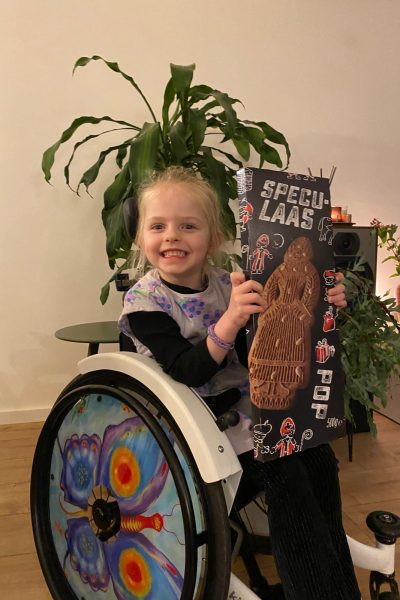
As a mother, there is nothing you want more than for your child to be happy. To play outside with friends, to run when he is excited, and to dream about the future without worrying about his body. For our son Tim, unfortunately, that is not something he can take for granted.
A different development as a baby
When Tim was still a baby, we noticed that his development was different from that of other children. While other parents proudly talked about their child's first steps, we worried about things that seem natural for many families. We wondered whether Tim would ever roll over on his own, learn to crawl, or eventually be able to walk independently. No one could tell us why moving was so difficult for him, why he fell so often, or why his body did not seem to cooperate the way it did for other children.
For years, we lived between hope and uncertainty. Physiotherapy, hospital visits, and medical examinations became a fixed part of our lives. We kept searching for answers while the questions continued to grow. Finally, when Tim was six years old, we received a diagnosis: Hereditary Spastic Paraplegia (HSP), a rare and progressive neuromuscular disease for which there is currently no cure. In Tim's case, the genetic cause remains unknown.
The diagnosis finally brought clarity, but at the same time it brought new worries. Although we now knew where his symptoms came from, the future remained uncertain. HSP is a disease that can increasingly affect daily life. As a parent, you find yourself wondering what your child will still be able to do in a few years. Which dreams will remain achievable? What challenges still lie ahead?
An ordinary boy with big dreams
Tim is now ten years old. He is a cheerful, funny, and curious boy who embraces life to the fullest. Like any other child, he has dreams, hobbies, and plans for the future. He wants to earn his swimming certificate, play football with his friends, and spend as much time as possible playing outside. But while other children rarely have to think about moving, it costs Tim extra energy every single day. After an afternoon of playing, he often suffers from painful and tired muscles. Sometimes his legs literally give way beneath him, and he realizes that things others take for granted can be enormous challenges for him.
What affects me most as a mother is not even the physical limitations. It is the moments when I see his frustration because his body will not do what he wants it to do. The disappointment when he notices that other children can do things that he cannot. The questions about the future that I simply cannot answer. No parent wants to wonder how much impact a disease will have on their child's life.
Yet there is something Tim shows us every single day: incredible resilience. Despite all the challenges, he remains positive. When something does not work, he tries again. When he falls, he gets back up. He keeps laughing, dreaming, and believing that tomorrow will bring new opportunities. His perseverance is an inspiration to everyone around him.
And that is exactly why we cannot give up hope.
Because this story is not only about Tim. It is about thousands of children, adults, and families living with HSP. People who face uncertainty, limitations, and questions about the future every day. For them, research is incredibly important. Only through more research can we better understand how HSP develops, how the disease progresses, and most importantly, how we can develop treatments that improve the lives of patients.
Give hope for the future
That is why I support Life4HSP. This foundation supports scientific research into HSP and works towards greater knowledge, better treatments, and ultimately the hope of a cure. To make this possible, funding is needed, which is why I have started a personal fundraising campaign.
With your support, you are helping not only researchers, but also families like ours. You are helping children who simply want to join in with their friends. You are helping parents who hope for answers and a better future for their child. Above all, you are giving hope.
Would you like to help us? Please support my campaign.
Every contribution, large or small, brings us one step closer to more knowledge, more possibilities, and hopefully one day a treatment.
So that we can tell children like Tim that there is perspective. That there is progress. That there is hope. And perhaps, one day, that there is a treatment.
 English (UK)
  Nederlands
  Français
  Italiano
  Deutsch
  Español